|
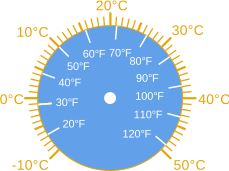
There are two main temperature scales: °C, the Celsius Scale (part of the Metric System, used in most countries) °F, the Fahrenheit Scale (used in the US) They both measure the same thing (temperature!), but use different numbers. Quick Celsius (°C) / Fahrenheit (°F) Conversion:
measure/images/thermometer.js?mode=boxes
Type a value in either box Or use the slider Or the Interactive Thermometer Or this method:
°C to °F
Divide by 5, then multiply by 9, then add 32
() Typical Temperatures(only bold are exactly the same)
°C
°F
Description
For these three conversions we can "flip the digits" (accurate within 1°): °C °F Oven Temperatures in the range 150°C to 200°C: double °C to get °F (accurate within 8°F):
°C
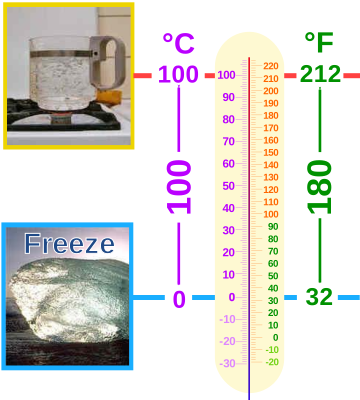
°F Going the other way: for the range 300°F to 400°F we can halve °F to get °C (accurate within 4°C). ExplanationCelsius and Fahrenheit both measure the same thing (temperature!), but use different numbers: Boiling water (at normal pressure) measures 100° in Celsius, but 212° in Fahrenheit And as water freezes it measures 0° in Celsius, but 32° in Fahrenheit Like this:
Looking at the diagram, notice: The scales start at a different number (0 vs 32), so we will need to add or subtract 32 The scales rise at a different rate (100 vs 180), so we will also need to multiply And so, to convert: from Celsius to Fahrenheit: first multiply by 180100, then add 32 from Fahrenheit to Celsius: first subtract 32, then multiply by 100180 180100 can be simplified to 95, and 100180 can be simplified to 59, so we get this:
°C to °F: Divide by 5, then multiply by 9, then add 32 °F to °C: Subtract 32, then multiply by 5, then divide by 9 Example: Convert 25° Celsius (a nice warm day) to Fahrenheit First: 25° / 5 = 5 Example: Convert 98.6° Fahrenheit (normal body temperature) to Celsius First: 98.6° − 32 = 66.6 We can swap the order of divide and multiply if we want, but don't change the add or subtract. So this is also OK: Example: Convert 98.6° Fahrenheit to Celsius (again) First: 98.6° − 32 = 66.6 (Same answer as before, was it easier or harder this way?) We can write them as formulas:Celsius to Fahrenheit: (°C × 95) + 32 = °F 9/5 is equal to 1.8, so we can also use this method: Celsius to Fahrenheit: °C × 1.8 + 32 = °F To make "×1.8" easier we can multiply by 2 and subtract 10%, but it only works for °C to °F: Celsius to Fahrenheit: (°C × 2) less 10% + 32 = °F Example: Convert 20° Celsius (A nice day) to Fahrenheit 20x2 = 40 less 10% is 40−4 = 36 36+32 = 68° F Add 40, Multiply, Subtract 40Since both scales cross at −40° (−40° C equals −40° F) we can: add 40, multiply by 5/9 (for °F to °C), or 9/5 (for °C to °F) subtract 40 Like this: Celsius to Fahrenheit: Add 40, multiply by 9/5, then subtract 40 Example: Convert 10° Celsius (A cool day) to Fahrenheit 10+40 = 50 50×9/5 = 90 90−40 = 50° F Quick, but Not AccurateCelsius to Fahrenheit: Double, then add 30 Examples °C → °F: 0° C → 0+30 → 30° F (low by 2°) 10° C → 20+30 → 50° F (exact!) 30° C → 60+30 → 90° F (high by 4°) 180° C → 360+30 → 390° F (high by 34°, not good) Examples °F → °C: 40° F → 10/2 → 5° C (almost right) 80° F → 50/2 → 25° C (low by about 2°) 120° F → 90/2 → 45° C (low by about 4°) 450° F → 420/2 → 210° C (low by about 22°, not good)
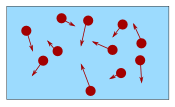
Footnote: Temperature is a measure of how fast an object's particles are moving. 1041, 1042, 1043, 1044, 3724, 3725, 3726, 3727, 3728, 3729 Copyright © 2025 Rod Pierce (责任编辑:) |