|
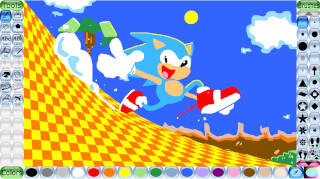
From the gallery: A Little Sonic Doodle by T I K I Tux Paint is easy to use, includes countless fun effects, and provides many configuration options.
Tux Paint works on Windows (Windows 7 through Windows 11), macOS (10.10 Yosemite and up), Android (including Chromebooks), Linux, and Haiku OS.
A number of useful drawing tools are made available. (See , below.) The drawing canvas is a fixed size, so the user doesn't need to worry about 'pixels' or 'inches' when making a new picture. The entire program fits on a screen as small as 640x480, and can be displayed full-screen, to hide the computer's underlying 'desktop' interface. (It defaults to 800x600 mode, but can run at larger sizes and in portrait or landscape mode, as well.) Loading and saving of images is done using thumbnails, so no knowledge of the underlying operating system's filesystem structure is needed. Even filenames are unnecessary. Images can be exported from Tux Paint (e.g., to your "Pictures" folder). Entertaining InterfaceFun sound effects are played when tools are selected and used. A cartoon version of Tux, the Linux penguin, appears at the bottom to give tips, hints and information. Drawing ToolsPaint brush Various brushes available Parents/teachers can add more brushes Brushes can be animated Brushes can change shape depending on the direction they're drawn Brushes can point the direction that's being drawn Brush spacing can be adjusted Alternate color palettes can be created and used Color picker, for choosing colors from a drawing Keyboard shortcut for quickly invoking the color picker Color mixer, for combining primary colors together Rubber stamp Hundreds of photographic and cartoon stamps images are available Parents/teachers can add more stamps and create categories Stamps can have descriptive text and sound samples (names, facts, etc.) and/or sound effects assigned to them Stamps can be resized, flipped and mirrored Rotate stamps Raster bitmaps (Portable Network Graphics ("PNG")) with full-color and alpha transparency (32bpp RGBA) supported Vector graphics (Scalable Vector Graphics ("SVG")) supported Line tool Uses Paint Brush's brushes 'Rubberband' shows where the line will be drawn as you move the mouse Fill 'Flood-fill' an area with a particular color Fill an area with a solid color Fill an area with a radial gradient Fill an area with a shaped gradient Interactively fill an area with a linear gradient Interactively fill an area with a solid color using freehand brushstrokes Erase an area via flood-fill, to expose the background Shape tool Draw various filled and unfilled polygonal shapes Rotate shapes Draw shapes from the center, or from a corner Text and Label tools 'Magic' (special effects) feature, with over 90 tools! Magic tools are grouped into related categories (this can be disabled ) Distorts Blur - blur parts of the picture using the mouse Sharpen - sharpen the focus of the picture Smudge - push the colors around as though smudging wet paint Blocks - turn parts of the picture 'blocky' Chalk - make parts of the picture look like a chalk drawing Drip - make parts of the picture look like it's dripping away Clone - clone parts of the picture; copy by painting () Distortion - slightly alters the position of the picture under the brush Puzzle - shift parts of your picture around like it's a sliding puzzle Circles - turn your picture into circular brush strokes Rays - turn your picture into linear brush strokes Edges - outline the edges of shapes in your picture Emboss - gives the image's edges highlights and shadows Silhouette - turn parts of your picture into a silhouette Fisheye - view parts of your picture through a fish-eye lense Ripples - rippled waves over your image Glass Tile - see your drawing through glass tiles Irregular Mosaic - turn your picture into a mosaic of shards Hexagon Mosaic - create a pattern of hexagons Square Mosaic - create a pattern of squares Mosaic - make your picture into a mosaic of colors TV - make your picture look like it's on a television ASCII Typewriter - transform your picture into "ASCII art", typewriter-style ASCII Computer - transform your picture into "ASCII art", computer terminal-style ASCII Color Computer - transform your picture into colored computer "ASCII art" Noise - add random noise to your picture Halftone - turn your picture into newsprint Color Filters Negative - invert the colors of parts of the picture Opposite - swap colors in the picture with their complementary colors Saturate - increase color saturation of parts of the picture Desaturate - reduce color saturation of parts of the picture Darken - darken the colors of parts of the picture Lighten - fade the colors of parts of the picture Remove Color - desaturate of parts of the picture that match a chosen color Keep Color - desaturate of parts of the picture that don't matching a chosen color Tint - change the color of parts of the picture Color & White - turn the picture monotone Cartoon - make parts of the picture look like a cartoon Color Shift - Jumble the colors of the picture Dither - turn your drawing into a dithered pattern of dots 3D Glasses - separate red/cyan, or other color combinations (), to create anaglyphic viewable with 3D glasses Color Sep. - separate color channels Double Vision - simulate double vision Xor colors - colors based on the position drawn on the picture Bloom - add a glowing "bloom" effect Picture Warps Mirror - flip the image horizontally Flip - flip the image vertically Shift - move the entire picture around Zoom - zoom your entire picture in or out Tile Zoom - zoom your entire picture in or out, tiling the results when scaling down Panels - divide and duplicate your drawing into a 2x2 grid Rush - zoom your entire picture in or out, blurring the results Perspective - bend your picture to view it from different perspectives Reflection - create a reflection of part of your picture Stretch - stretch and squash parts of the picture Waves - wiggle your picture side to side Wavelets - wiggle your picture up and down Fold - fold down the corners of your picture Kaleido-4, Kaleido-6, & Kaleido-8 - view your drawing through a kaleidoscope Rotate - rotate your picture Painting Pattern Painting Symmetry Left/Right - paint with reflective symmetry across the horizontal center of the image Symmetry Up/Down - paint with reflective symmetry across the vertical center of the image Kaleidoscope - four symmetric brushes Pattern - draws a tiled pattern around the picture Tiles - draws a symettric pattern around the picture Rosette - three brushes that draw in a rosette pattern Picasso - a triplet of brushes that paint in unison Tessellation Pointy - draws a tessellation with a pointy-topped hexagon pattern Tessellation Flat - draws a tessellation with a flat-topped hexagon pattern Picture Decorations Blind - pull window blinds down, or across, the picture Checkerboard - fill the picture with a checkerboard pattern Snow Ball - cover your picture in snowballs Snow Flake - cover your picture in snowflakes Projections 1-point Perspective - set a vanishing point and draw lines with 1-point perspective 2-point Perspective - set two vanishing points and draw lines with 2-point perspective 3-point Perspective - set three vanishing points and draw lines with 3-point perspective Isometric - draw in an isometric projection Dimetric - draw in a dimetric projection Trimetric - draw in a trimetric projection Oblique - draw in an oblique projection Artistic Flower - draws curvy-stalked flowers Googly Eyes - add googly eyes to your picture Real Rainbow - draw a colorful arc based on a real photo of a rainbow ROYGBIV Rainbow - draw a rainbow arc of seven solid colors Lightning - draw lightning bolts on your picture Tornado - add a tornado funnel to your picture Filled Polygon - create filled polygons by placing 3 or more points String edges - draw string art around the edges of your picture String corner - draw string art String V - draw V-shaped string art Epitrochoid - creates cyclical ("Spirograph"-like) patterns generated by a circle rolling on the outer edge of another circle Hypotrochoid - creates cyclical ("Spirograph"-like) patterns generated by a circle rolling on the inner edge of another circle Many magic tools offer multiple size options Many magic tools work in both freehand and full-canvas modes Some magic tools react to complexity (user "expertise-level") settings ... plus, programmers can easily and quickly create new 'Magic' tools using a plug-in interface! Eraser Square, round, fuzzy-edged, and transparent erasers of various sizes Use to expose parts of the background color, Template, or Starter after drawing on it Keyboard shortcut for quickly accessing a small eraser Undo Multiple levels of undo Undo actions can themselves be undone with the 'Redo' button CommandsNew Create a new drawing with a blank canvas, a pre-drawn backdrop, or a coloring-book-style outline Save Save a picture to the virtual 'picturebook' One-click save: No file browser dialogs or filename prompts are used If saving an opened picture, choose to save over it (like 'Save' in desktop programs), or save a new picture (like 'Save As') Open Open a previous drawing by selecting its thumbnail in a virtual 'picturebook' Delete previously-saved pictures. On these platforms, images are moved to the 'Trash' or 'Recycle Bin': Linux/Unix Windows macOS Option allows reversing order of images in the Open dialog Slides View a slideshow of multiple saved drawings Control the speed of playback; create class presentations or simple looping animations Go forward or back using the arrow keys or mouse Slideshows can be exported from Tux Paint as animated GIFs, for sharing on the Internet Starters Various coloring-book-style images included Photographic scenes included, with foreground and background elements that you draw in between Vector graphics (Scalable Vector Graphics ("SVG")) supported Kid Pix templates ("KPX" files) supported Templates Photographic backgrounds that you can draw on; use the Eraser tool to reveal them Turn your own pictures into a new Template right inside Tux Paint Print pictures on a printer TranslationsParts of Tux Paint have currently been translated into the following languages: (129) Acholi Afrikaans Akan Albanian Amharic Arabic Aragones Armenian Assamese Asturian Azerbaijani Bambara Basque Belarusian Bengali Bodo Bosnian Breton Bulgarian Catalan Chinese (Simplified) Chinese (Traditional) Croatian Czech Danish Dogri Dutch English (Australian) English (British) English (Canadian) English (South African) English (USA) Esperanto Estonian Faroese Finnish French Fula Gaelic (Irish) Gaelic (Scottish) Galician Georgian German Greek Gronings Gujarati Hebrew Hindi Hungarian Icelandic Indonesian Inuktitut Italian Japanese Kabyle Kannada Kashmiri (Devanagari) Kashmiri (Perso-Arabic) Khmer Kiga Kinyarwanda Klingon Konkani Konkani (roman) Korean Korean Kurdish Latvian Lithuanian Luganda Luxembourgish Macedonian Maithili Malay Malayalam Manipuri (bengali) Manipuri (meitei mayek) Marathi Miahuatlán Zapotec Mongolian Ndebele Nepali Northern Sotho Norwegian Bokmål Norwegian Nynorsk Occitan Odia Ojibwe Persian Polish Portuguese (Brazilian) Portuguese (Portugal) Punjabi Romanian Russian Sanskrit Santali (devanagari) Santali (ol chiki) Serbian (cyrillic) Serbian (latin) Shuswap Sindhi Sindhi (Devanagari) Sinhala Slovak Slovenian Songhay Spanish (Mexican) Spanish (Spanish) Sundanese Swahili Swedish Tagalog Tamil Telugu Thai Tibetan Turkish Twi Ukrainian Urdu Valencian Venda Venetian Vietnamese Walloon Welsh Wolof Xhosa Zulu (You can even help translate it to your favorite language.) International Character InputEnter text in different languages using the Text tool: Latin languages - Spanish, French, Italian, Portuguese, etc. Japanese - Romanized Hiragana and Romanized Katakana Korean - Hangul Bul-2 Thai Traditional Chinese AccessibilityTux Paint provides a number of optional accessibiltiy enhancements, to help make the program more suitable in some circumstances. Parental and Teacher ControlsRun Tux Paint in full-screen mode, or have it 'grab' the mouse pointer, to prevent children from accidentally accessing other programs or files on the desktop. Sound effects can be deactivated. The Print and Quit options can be deactivated. Alternatively, the Print option can be limited to allow only one print every n minutes. By default, Tux Paint cannot be launched more than once every 30 seconds, to prevent multiple copies from being run accidentally, due to over-eager mouse clicking. The directories/folders where Tux Paint saves and/or exports files may be changed. This can allow saving pictures in a student's home directory on a network drive or shared drive, rather than locally on one particular workstation. Stamps, starters and brushes are stored using popular open formats (PNG, SVG, Ogg Vorbis, etc.) allowing parents and teachers to create their own content for use at home or in the classroom - even using completely free tools. The 'Tux Paint Config.' program allows parents, teachers, and school technicians to alter Tux Paint's behaviour using a simple, easy-to-use graphical interface. (It's separate from Tux Paint, to prevent children from changing things.) ... and much more! 🐻 Feature may be simplified or deactivated, simplifying Tux Paint to increase accessibility (e.g., for novice users). (责任编辑:) |