|
Latest Updates
Book Free Demo : One-to-One Learning - Any Topic, Any TimeUnderstand Multiplication: Core Terms, Properties, and Examples There are four basic operations of Mathematics; these are addition, subtraction, multiplication, and division. So, multiplication is one of the elementary operations of computation in Mathematics. There are a lot of terminologies that are used in multiplication which come under multiplication vocabulary. The multiplication of two numbers (e.g. 2 2) is equivalent to adding as many copies of one of them. We are required to know the meaning of these terminologies. In this article, we will learn about the words of multiplication vocabulary and their meaning as well.
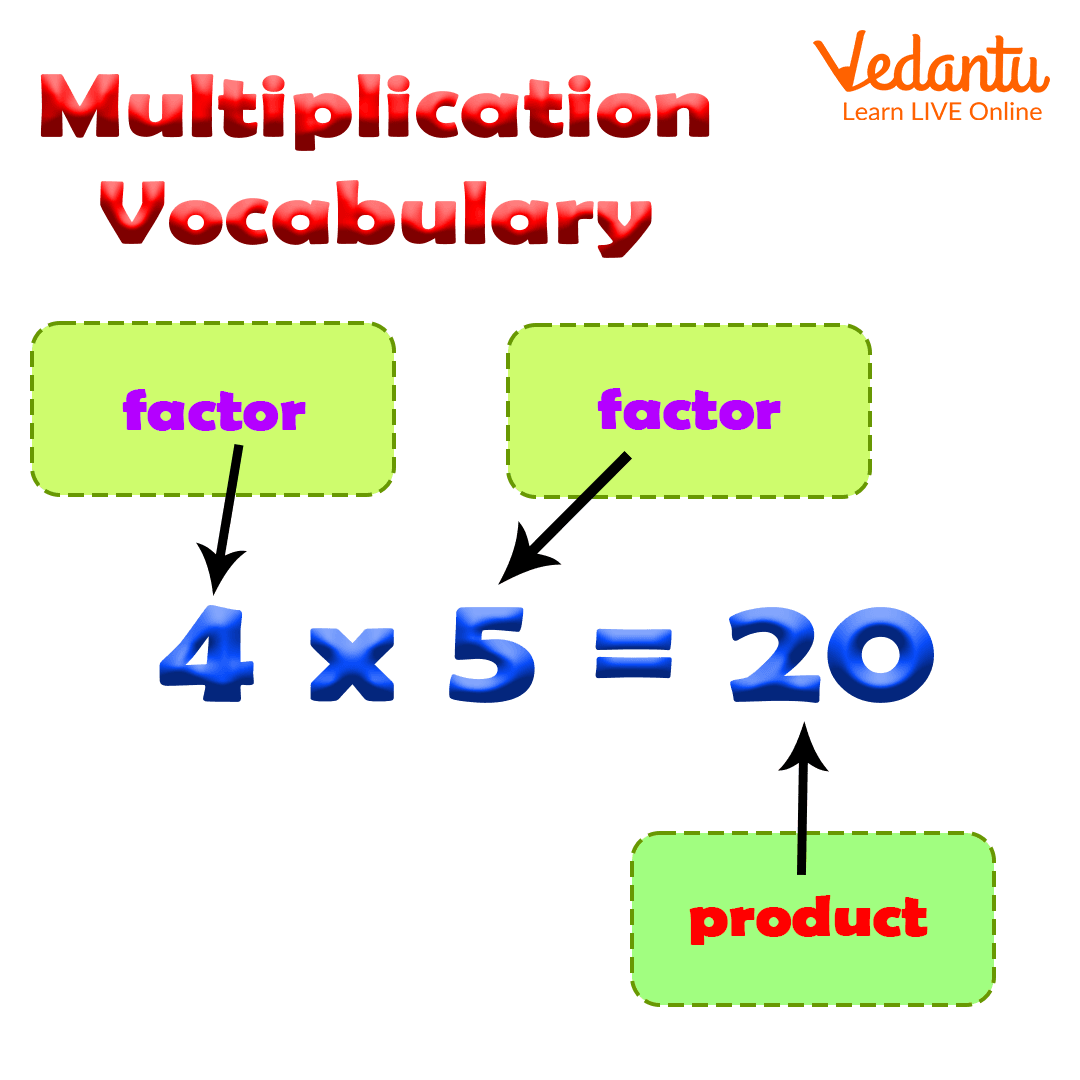
Basic terminology of multiplication The list of multiplication vocabulary words is given below with their meanings. Sr. No. Words Meaning 1 Multiple Multiple is defined as the product of a given whole number with any whole number. 2 Factor Numbers that are used in multiplication for multiplying together to get a product. 3 Multiplier Multiplier is the number with which we perform the operation of multiplication. 4 Multiplicand In the process of multiplication, the number to be multiplied is termed the multiplicand. 5 Product Product is the result we obtain when we multiply two factors together. 6 Square number The square number is the product of a number multiplied by itself. For example, 22=4. 7 Composite number A composite number is a whole number that is greater than one that has more than two different factors. 8 Multiplication The multiplication of two numbers is similar to doing the addition of many copies of one of them. There are some important properties that are related to multiplication which are discussed below. Commutative property of multiplication According to the commutative property of multiplication, when the order ofmultiplier and multiplicand are changed, the product does not change. For example, 8 × 6 = 48 or 6 × 8 = 48 So, 8 × 6 = 6 × 8. Associative property of multiplication According to the associative property of multiplication, the product of three or more numbers does not change if we change the grouping of the numbers. For example: (3 × 8) × 5 = 24 × 5 = 120 or, (3 × 5) × 8 = 15 × 8 = 120 or, (8 × 5) × 3 = 40 × 3 = 120 One property of multiplication According to one property of multiplication, the product of a number and 1 is the number itself. For example: 4 × 1 = 4 5 × 1 = 5 23 × 1 = 23 21× 1 = 21 Zero property of multiplication According to the zero property of multiplication, the result of multiplication of any number and zero is zero. For example: 6 × 0 = 0 0 × 34 = 0 8 × 0 = 0 80 × 0 = 0 Distributive property of multiplication According to the distributive property of multiplication, the product of a number and the sum of two numbers is always the same as the sum of the product of the numbers. For example: 6 × (3 + 8) = 6 × 11 = 66 6 × 3 + 6 × 8 = 66 So, 6 × (3 + 8) = 6 × 3 + 6 × 8 = 66 In the same way, the product of a number and the difference of two numbers is also always the same as the difference of the product of the numbers. For example: 3 × (6 − 5) = 3 3 × 6 − 3 × 5 = 18 − 15 = 3 So, 3 × (6 − 5) = 3 × 6 − 3 × 5 = 3 In the above article, all the words related to multiplication are described and the properties of multiplication are explained with examples. This article will help students to develop a strong concept of multiplication. FAQs on Essential Multiplication Vocabulary Every Student Should Know 1. What is multiplication in simple terms? Multiplication is one of the four basic maths operations. It's essentially a quick way of performing repeated addition. For example, instead of adding 5 four times (5 + 5 + 5 + 5), you can simply multiply 5 by 4 to get the same result, which is 20. 2. What are the main terms used in multiplication? The core vocabulary for multiplication includes several key terms: Multiplicand: The number that is being multiplied. Multiplier: The number by which you multiply the multiplicand. Product: The final result or answer of the multiplication. Factor: A general term for any of the numbers that are multiplied together to get a product. Both the multiplicand and multiplier are considered factors. 3. What are the 5 main properties of multiplication? The five fundamental properties of multiplication that help in solving problems more easily are: Commutative Property: Changing the order of factors does not change the product (e.g., 4 × 5 is the same as 5 × 4). Associative Property: Changing the grouping of three or more factors does not change the product (e.g., (2 × 3) × 4 gives the same result as 2 × (3 × 4)). Distributive Property: Multiplying a number by a group of numbers added together is the same as doing each multiplication separately (e.g., 5 × (2 + 3) = 5 × 2 + 5 × 3). Identity Property of Multiplication: The product of any number and 1 is always the number itself (e.g., 7 × 1 = 7). Zero Property of Multiplication: The product of any number and 0 is always 0 (e.g., 9 × 0 = 0). 4. How is the commutative property different from the associative property of multiplication? The main difference lies in what is being changed in the multiplication problem. The Commutative Property is about the order of two numbers; it means you can swap them without changing the answer (e.g., 8 × 2 = 2 × 8). The Associative Property is about the grouping of three or more numbers; it means you can change which numbers you multiply first (e.g., (2 × 3) × 4 = 2 × (3 × 4)). 5. How does the distributive property help in solving maths problems faster? The distributive property is a powerful tool for mental math and simplifying calculations with larger numbers. For example, to solve 18 × 7, you can break 18 into (10 + 8). Using the distributive property, the problem becomes (10 × 7) + (8 × 7), which equals 70 + 56. This is much easier to calculate mentally as 126. 6. Why is the zero property of multiplication important? The zero property is crucial because it establishes a universal rule in mathematics: multiplying any number by zero always results in zero. This is a foundational concept that simplifies complex equations. In higher maths like algebra, it's essential for finding the solutions to equations, where if a product equals zero, at least one of its factors must be zero. 7. Does division have a commutative property like multiplication? Why or why not? No, division is not commutative. This means that changing the order of the numbers in a division problem will change the final answer. For example, 10 ÷ 2 equals 5, but 2 ÷ 10 equals 0.2. Since the results are different, it proves that order is critical in division, unlike in multiplication where 10 × 2 is the same as 2 × 10. Recently Updated Pages Master Maths Concepts & Formulas | Fast Learning Guide
1 Yard in Feet: Easy Yard to Feet Conversion Explained
Math Symbols: List, Meanings & Easy Examples for Students
MM to Inches Conversion Made Easy: Formula, Chart & Guide
Arzela Ascoli Theorem: Statement, Proof, Applications & Examples
Differential Equations - Explanation, Types, Order and Degree, and Applications
Master Maths Concepts & Formulas | Fast Learning Guide
1 Yard in Feet: Easy Yard to Feet Conversion Explained
Math Symbols: List, Meanings & Easy Examples for Students
MM to Inches Conversion Made Easy: Formula, Chart & Guide
Arzela Ascoli Theorem: Statement, Proof, Applications & Examples
Differential Equations - Explanation, Types, Order and Degree, and Applications
1 2 Trending topics Calendars in Maths: Rules, Shortcuts, and Examples
Metric Length Made Simple: SI Units & Conversions
Greater Than and Less Than Symbols: Easy Guide for Maths Students
How to Convert Rupees Into Paise: Simple Methods and Examples
How to Write Rupees and Paise in Words Easily
Maths Quiz Questions with Answers: Practice for Class 6 to 10 Exams
Calendars in Maths: Rules, Shortcuts, and Examples
Metric Length Made Simple: SI Units & Conversions
Greater Than and Less Than Symbols: Easy Guide for Maths Students
How to Convert Rupees Into Paise: Simple Methods and Examples
How to Write Rupees and Paise in Words Easily
Maths Quiz Questions with Answers: Practice for Class 6 to 10 Exams
1 2 Other Pages Important Days and Dates in December 2025
Important Days and Dates in November 2025: Complete Guide for Students
Number to Words Converter – Translate Numbers to Words Easily
Dr B. R. Ambedkar Short Biography
General Knowledge Questions with Answers
Salary of MLAs in India
Important Days and Dates in December 2025
Important Days and Dates in November 2025: Complete Guide for Students
Number to Words Converter – Translate Numbers to Words Easily
Dr B. R. Ambedkar Short Biography
General Knowledge Questions with Answers
Salary of MLAs in India
|