|
Better ways to collect and process blood and treat and transfuse patients greatly expanded the pool of potential surgical patients and improved survivability of wounded soldiers. World War II brought advances in military medicine that were disseminated by the College through a series of "War Sessions." 1940 Dr. Owen Wangensteen Proposes Surgical Forum
1940Dr. Owen Wangensteen Proposes Surgical Forum
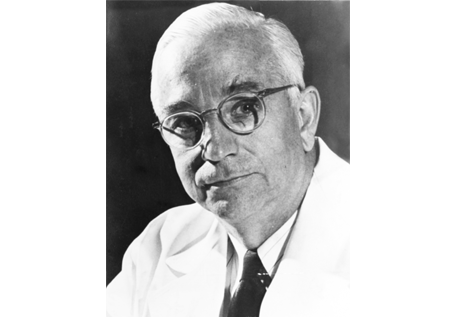
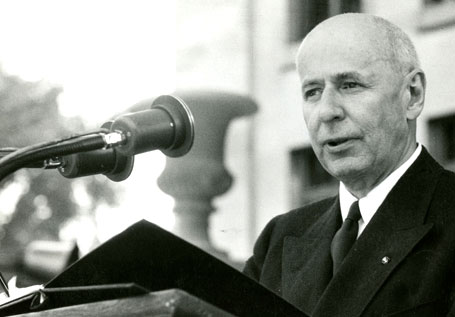
Owen Wangensteen, MD, FACS, chair of surgery at the University of Minnesota, believed that young surgeons, rather than seeing themselves as apprentices, should be encouraged to engage in independent thought and research. "It is important that young and productive workers in surgery be provided an opportunity early in their career for active participation in surgical meetings before the ravages of time dampen their enthusiasm."65,66 Dr. Wangensteen proposed the establishment of an idea-and-research exchange forum for up-and-coming surgeons in a 1940 editorial in Surgery entitled, "The Society of University Surgeons and the Need for a Surgical Forum." The following year, the Forum on Fundamental Surgical Problems debuted at the Clinical Congress.67,68 When the first published volume of the Surgical Forum appeared in 1951, Evarts A. Graham, MD, FACS, called it "a unique institution that is not found in any other country and that represents a potent factor in making American surgery the strong and innovative profession that it is."
Dr. Michael DeBakey Invents Roller Pump for Transfusions 1940Dr. Michael DeBakey Invents Roller Pump for Transfusions
A 23-year-old Tulane University medical student named Michael DeBakey (later MD, FACS) invented the roller pump for use in a direct donor-to-patient transfusion.69 The pump rhythmically propelled fluid through a flexible tube, and its ability to replicate the rhythmic pulsing of the human heart earned it the name "peristaltic pump."70 Two decades later, Dr. DeBakey's device would become the driving component of the heart-lung machine (see 1953) to provide the patient with continuous blood flow during an open heart procedure. 1941 Dr. Charles Drew Advances Techniques to Collect and Process Blood Plasma
1941Dr. Charles Drew Advances Techniques to Collect and Process Blood Plasma
In anticipation of mass casualties from Hitler's expected invasion of Great Britain, the U.S. organized a Plasma for Great Britain effort. Administering the effort was Charles Drew, MD, FACS,71 who was recommended for the position on the strength of his 1940 doctoral thesis on blood preservation techniques.72 Dr. Drew created locations in eight New York City hospitals where volunteers could donate blood for wounded soldiers. He took the successful laboratory experiments of many blood researchers and transformed their methods into mass production techniques.73 For example, on learning that the British had successfully modified an ordinary cream separator to separate plasma from the red blood cells, Dr. Drew ordered two of the machines from England as prototypes and then had similar equipment constructed in the United States so that clear plasma could be produced on a large scale. Although the Plasma for Britain Project was terminated when Hitler's invasion failed to materialize, America's imminent entry into the war prompted an effort to stockpile blood reserves for U.S. soldiers.
Albumin Used to Save Burn Victims in Pearl Harbor Attack 1942Albumin Used to Save Burn Victims in Pearl Harbor Attack
Called by the U.S. government to inspect and treat patients injured during the Pearl Harbor attack, Philadelphia surgeon Isidor S. Ravdin, MD, FACS, decided to bring a supply of albumin with him to Hawaii. Albumin was a new substance, separated from plasma and developed by Edwin Cohn, a professor of biological chemistry at Harvard Medical School. Dr. Ravdin used the plasma substitute to treat seven severely burned patients, including one patient whose condition was so critical that "the administration of albumin to him was debatable," Dr. Ravdin said. By the end of the first day, the patient was talking; by the next day, the patient's swelling had subsided and "he was taking food by mouth."74 Injected into the bloodstream, albumin increased the patient's blood volume by absorbing liquid from surrounding tissues, and prevented the patient's blood vessels from collapsing, helping him avoid going into shock.75 1942-1944 Grimm Suggested War Sessions
1942-1944Grimm Suggested War Sessions
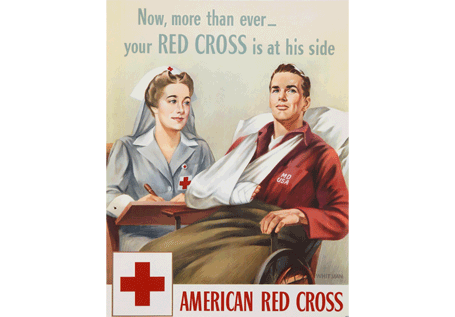
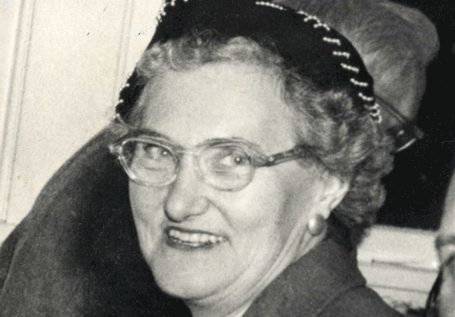
The College replaced its sectional meetings with "War Sessions" throughout the U.S. and Canada, which were designed to help teach the many physicians and surgeons who were about to enter the Army how to care for military wounds.76 The War Sessions were suggested by Eleanor K. Grimm, the longtime secretary of Franklin H. Martin, MD, FACS. Ms. Grimm was widely regarded as the College's de facto chief administrative officer after Dr. Martin's death in 1935 (Dr. Martin was not replaced as executive director until Major General Paul Hawley, MD, FACS (Hon), joined the College in 1950).77,78 There were more than 20 of these community meetings over the three years that were attended by surgeons, enlisted medical officers, civilian practitioners, and hospital administrators. They included film footage of the actual medical, surgical, and hospital activities in the various theaters of operation, talks from medical officers about triage, evacuation, and field and evacuation hospitals, and presentations on the latest methods of treating wounds, burns, and fractures. The speakers offered statistics on the number of casualties they treated, the locations of wounds, how they were managed, and their results. The College also published an annual War Issue of the Bulletin during this time, which disseminated information about College activities and changes that impacted the profession during the war.79
Dr. Edward D. Churchill Leads Advances in Military Medicine 1942-1945Dr. Edward D. Churchill Leads Advances in Military Medicine
As Theater Commander for Surgery in the Mediterranean during World War II, Col. Edward D. Churchill, MD, FACS, developed the use of delayed primary closure and early debridement of contaminated wounds and improved the air evacuation process for treating wounded soldiers. He also mentored many junior surgeons and challenged Army leadership to treat hemorrhagic shock with blood rather than plasma.80 Dr. Churchill describes many of these activities in his memoir, Surgeon to Soldiers.81 1945 "Blue Babies" Successfully Treated
1945"Blue Babies" Successfully Treated
Before the publication of their landmark paper, "The Surgical Treatment of Malformations of the Heart: in which there is Pulmonary Stenosis or Pulmonary Atresia," a "blue baby" with a malformed heart had been "considered beyond the reach of surgical aid,"82 according to coauthors Alfred Blalock MD, FACS, and pediatric cardiologist Helen Taussig, MD. Their paper, published in the Journal of the American Medical Association, reported on three pediatric cases in which cyanotic children were cured by an operation pioneered by Drs. Blalock and Taussig, and surgical assistant, Vivien Thomas. The blue baby syndrome, or "tetralogy of Fallot," consists of a hole in the wall between the heart's two major chambers (ventricles), an enlarged right ventricle, a defective pulmonary valve that prevents full flow of blood to the lung, and cyanosis.83 Cyanosis is indicated outwardly by blueness and caused by the lung's inability to oxygenate sufficient blood for the system. Dr. Blalock operated on an infant with tetralogy of Fallot and created the first Blalock-Taussig shunt between the subclavian artery and the pulmonary artery. Thomas' key role in the surgery, surgical techniques, and devices84 was little known until his autobiography85 was published in 1985. His role was popularized by a 2003 documentary86 and a 2004 television movie.87 |