|
This article is about the monarchy of Tuvalu. For information on the other countries which share the same monarchy, see Commonwealth realm. Queen of TuvaluMonarchy
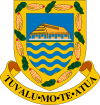
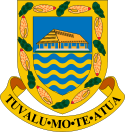
Coat of arms of Tuvalu
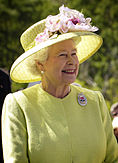
Incumbent: Elizabeth II Style: Her Majesty Heir apparent: Charles, Prince of Wales First monarch: Elizabeth II Formation: October 1, 1978 Tuvalu
This article is part of the series: Governor-General Prime Minister Cabinet Parliament Elections and parties Foreign relations Other countries · Atlas The monarchy of Tuvalu (the Tuvaluan monarchy) is a system of government in which a hereditary monarch is the sovereign of Tuvalu. The present monarch of Tuvalu is Queen Elizabeth II. Tuvalu shares the sovereign with 15 other Commonwealth realms. The Queen's constitutional roles are mostly delegated to the Governor-General of Tuvalu. Royal succession is governed by the English Act of Settlement of 1701, which is part of constitutional law. In the first years of the 21st century the issue of abolishing the monarchy was raised by local politicians, but a constitutional referendum held on 30 April 2008 turned out 1,260 to 679 votes in favour of retaining the monarchy. Contents
International and domestic role One of the most complicated features of the Tuvaluan monarchy is that it is a shared monarchy. Fifty-four states are members of the Commonwealth of Nations. Sixteen of these countries are specifically Commonwealth realms who recognise, individually, the same person as their Monarch and Head of State; Tuvalu is one of these. Despite sharing the same person as their respective national monarch, each of the Commonwealth realms—including Tuvalu—is sovereign and independent of the others. Development of shared monarchyThe Balfour Declaration of 1926 provided the dominions the right to be considered equal to Britain, rather than subordinate; an agreement that had the result of, in theory, a shared Crown that operates independently in each realm rather than a unitary British Crown under which all the dominions were secondary. The Monarchy thus ceased to be an exclusively British institution, although it has often been called "British" since this time (in both legal and common language) for reasons historical, legal, and of convenience. The Royal and Parliamentary Titles Act, 1927 was the first indication of this shift in law, further elaborated in the Statute of Westminster, 1931. Tuvalu achieved independence in 1978 but retained the Queen as Head of State. Under the Statute of Westminster, Tuvalu has a common monarchy with Britain and the other Commonwealth realms, and though laws governing the line of succession to the Tuvaluan throne lie within the control of the Tuvaluan Parliament, Tuvalu cannot change the rules of succession without the unanimous consent of the other realms, unless explicitly leaving the shared monarchy relationship by means of a constitutional amendment. This situation applies symmetrically in all the other realms, including the UK. On all matters of the Tuvaluan State, the Monarch is advised solely by Tuvaluan ministers. 16 June remains a public holiday as the Queen's Official Birthday. The Queen of Tuvalu and the Duke of Edinburgh have only paid one visit to Tuvalu on 26-27 October 1982. The royal couple were carried around in ceremonial litters and later served with traditional local dishes on a banquet. A sheet of commemorative stamps were issued for the royal visit. Former Prime Minister Sir Kamuta Latasi was knighted by the Queen in 2008 although he is noted for his republican leanings in Tuvaluan politics. TitleIn Tuvalu, the Queen's official title is: Elizabeth the Second, by the Grace of God, Queen of Tuvalu and of Her other Realms and Territories, Head of the Commonwealth. This style communicates Tuvalu's status as an independent monarchy, highlighting the Monarch's role specifically as Queen of Tuvalu, as well as the shared aspect of the Crown throughout the realms. Typically, the Sovereign is styled "Queen of Tuvalu," and is addressed as such when in Tuvalu, or performing duties on behalf of Tuvalu abroad. Constitutional roleThe Tuvaluan constitution is made up of a variety of statutes and conventions that are either British or Tuvaluan origin, which gives Tuvalu a similar parliamentary system of government as the other Commonwealth realms. All powers of state are constitutionally reposed in the Monarch, who is represented by the Governor General of Tuvalu — appointed by the Monarch upon the advice of the Prime Minister of Tuvalu the Monarch is informed of the Prime Minister's decision before the Governor General gives Royal Assent. DutiesMost of the Queen's domestic duties are performed by the Governor General. The Governor-General represents the Queen on ceremonial occasions such as the opening of Parliament, the presentation of honours and military parades. Under the Constitution, he is given authority to act in some matters, for example in appointing and disciplining officers of the civil service, in proroguing Parliament. As in the other Commonwealth realms, however, the Monarch's role, and thereby the vice-regent's role, is almost entirely symbolic and cultural, acting as a symbol of the legal authority under which all governments operate, and the powers that are constitutionally hers are exercised almost wholly upon the advice of the Cabinet, made up of Ministers of the Crown. It has been said since the death of Queen Anne in 1714, the last monarch to head the British cabinet, that the monarch "reigns" but does not "rule". In exceptional circumstances, however, the Monarch or vice-regal can act against such advice based upon his or her reserve powers. There are also a few duties which must be specifically performed by, or bills that require assent by the Queen. These include: signing the appointment papers of Governors General, the confirmation of awards of honours, and approving any change in her title. It is also possible that if the Governor General decided to go against the Prime Minister's or the government's advice, the Prime Minister could appeal directly to the Monarch, or even recommend that the Monarch dismiss the Governor General. Succession
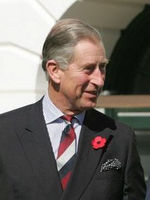
Succession to the throne is by male-preference primogeniture, and governed by the provisions of the Act of Settlement, as well as the English Bill of Rights. These documents, though originally passed by the Parliament of England, are now part of the Tuvaluan constitutional law, under control of the Tuvaluan parliament only. This legislation lays out the rules that the Monarch cannot be a Roman Catholic, nor married to one, and must be in communion with the Church of England upon ascending the throne. As Tuvalu's laws governing succession are currently identical to those of the United Kingdom (by the Statute of Westminster) see Succession to the British Throne for more information. The heir apparent is Elizabeth II's eldest son, Charles, who has no official title outside of the UK, but is accorded his UK title, Prince of Wales, as a courtesy title. Legal roleAll laws in Tuvalu are enacted with the sovereign's, or the vice-regal's signature. The granting of a signature to a bill is known as Royal Assent; it and proclamation are required for all acts of Parliament, usually granted or withheld by the Governor General. The Vice-Regals may reserve a bill for the Monarch's pleasure, that is to say, allow the Monarch to make a personal decision on the bill. The Monarch has the power to disallow a bill (within a time limit specified by the constitution). The Sovereign is deemed the "fount of justice," and is responsible for rendering justice for all subjects. The Sovereign does not personally rule in judicial cases; instead, judicial functions are performed in his or her name. The common law holds that the Sovereign "can do no wrong"; the monarch cannot be prosecuted in his or her own courts for criminal offences. Civil lawsuits against the Crown in its public capacity (that is, lawsuits against the government) are permitted; however, lawsuits against the Monarch personally are not cognizable. The Sovereign, and by extension the Governor General, also exercises the "prerogative of mercy," and may pardon offences against the Crown. Pardons may be awarded before, during, or after a trial. In Tuvalu the legal personality of the State is referred to as "Her Majesty the Queen in Right of Tuvalu." For example, if a lawsuit is filed against the government, the respondent is formally described as Her Majesty the Queen in Right Tuvalu. The monarch as an individual takes no more role in such an affair than in any other business of government. Referendum of 2008In the first years of the 21st century there was a debate about the abolition of the monarchy. Prime Minister Saufatu Sopoanga had stated in 2004 that he was in favour of replacing the Queen as Tuvalu's head of state, a view supported by popular former Prime Minister Ionatana Ionatana; Sopoanga also stated that public opinion would be evaluated first before taking any further moves. Former Prime Minister Kamuta Latasi also supported the idea. A referendum was held in Tuvalu in 2008, giving voters the option of retaining the monarchy, or abolishing it in favour of a republic. The monarchy was retained with 1,260 votes to 679 (64.98%). Turnout was low, with about 2000 voters of a potential 9000 taking part. References
Government The Monarchy Today > Queen and Commonwealth Staff writer (2008-04-30). "Tuvaluans vote against Republic". Tuvalu Islands. . Retrieved 2008-06-17. The Monarchy Today > Queen and Commonwealth > Members
Chapman, Paul (2004-05-06). "Tuvalu may ditch the Queen and declare a republic". telegraph.co.uk. ?xml=/news/2004/05/06/wmaori106.xml. Retrieved 2006-06-30. "Tuvalu votes to maintain monarchy", Radio Australia, June 17, 2008 "Tuvaluans vote against republic, Tuvalu News, April 30, 2008 · · e Commonwealth realmsCurrent
Antigua and Barbuda · Australia · Bahamas · Barbados · Belize · Canada · Grenada · Jamaica · New Zealand · Papua New Guinea · St Kitts and Nevis · St Lucia · St Vincent and the Grenadines · Solomon Islands · Tuvalu · United Kingdom Former
Ceylon · Fiji · Gambia · Ghana · Guyana · India1 · Ireland1 · Kenya · Malawi · Malta · Mauritius · Newfoundland2 · Nigeria · Pakistan · Rhodesia3 · Sierra Leone · South Africa · Tanganyika · Trinidad and Tobago · Uganda 1 Dominion, became republic before adoption of the term "realm" · · eQueen Elizabeth II Monarchies
Titles and honours Overseas visits Public celebrations (责任编辑:) |